WiFi-JEPA: Self-supervised Learning for WiFi-CSI 3D Human Pose Estimation
Abstract
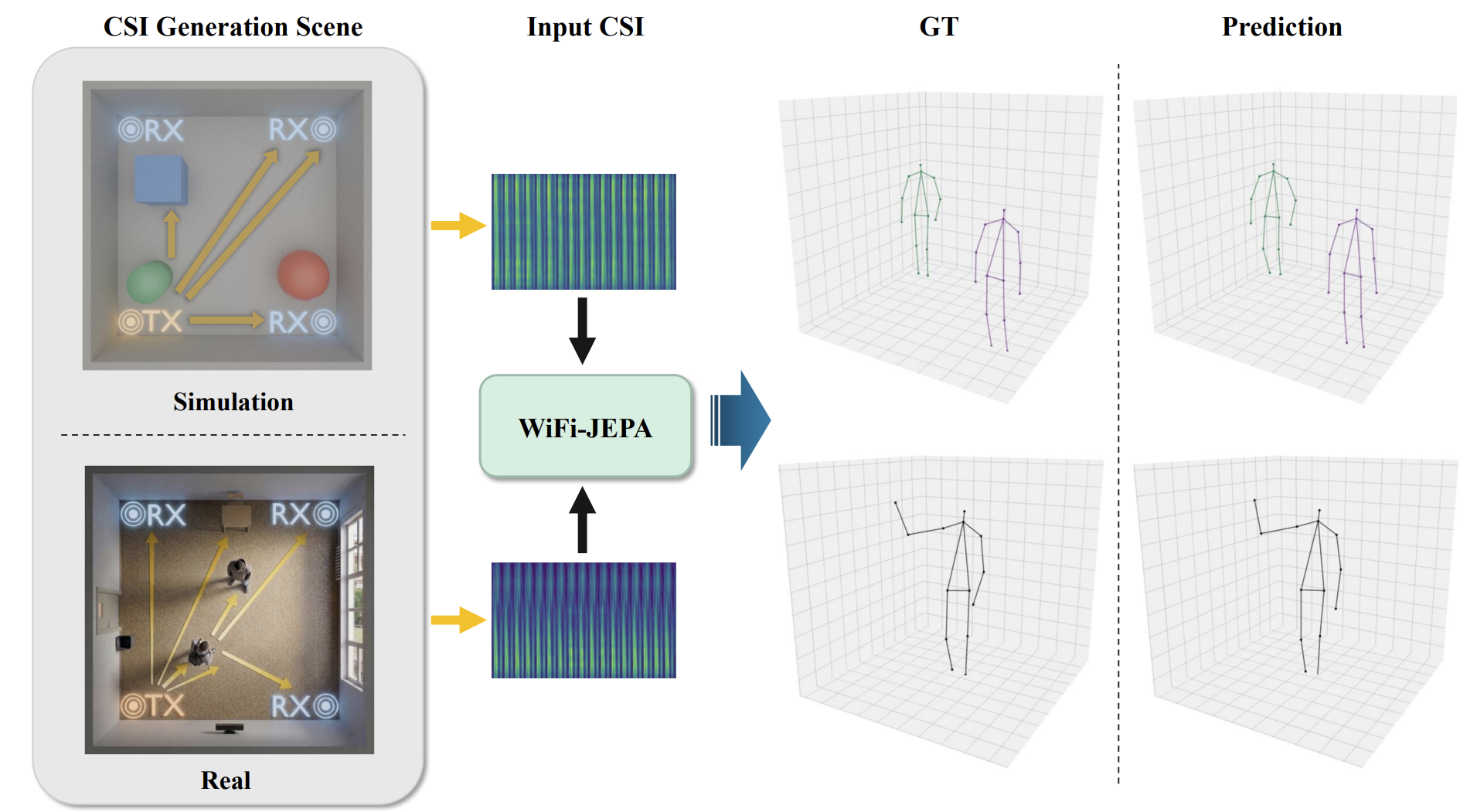
WiFi Channel State Information (CSI) enables privacy-preserving human pose sensing in camera-denied environments, but existing WiFi-based pose estimators often fail under environment shifts and rely on costly camera-based annotation pipelines that limit scale. We propose WiFi-JEPA, a self-supervised framework that learns CSI-native representations by predicting masked latent embeddings instead of reconstructing raw CSI signals that may contain hardware-specific artifacts. WiFi-JEPA makes three contributions: (i) CSI-specific tokenization and link masking tailored to the CSI tensor over channel, time, and link (C, T, L); masking entire Tx–Rx antenna links forces the model to predict one spatial link view from others, capturing cross-link correlations informative of 3D spatial structure. (ii) A ray-tracing CSI simulation pipeline that generates diverse unlabeled CSI from randomized geometric primitives, providing scalable pre-training data without pose annotations. (iii) State-of-the-art results on Person-in-WiFi-3D: WiFi-JEPA outperforms prior WiFi-CSI baselines on both single- and multi-person 3D pose estimation under the same evaluation protocol. We also show that simulated CSI provides complementary pre-training signal to real CSI, and that four vision-native SSL objectives degrade performance below training from scratch, whereas WiFi-JEPA consistently improves downstream pose estimation.
Method
CSI-specific tokenization. WiFi-JEPA keeps the CSI tensor factored as (C, T, L) — 60 subcarriers, 20 time steps, and 9 antenna links — embedding each (time, link) coordinate as its own token. Link masking. Entire antenna links (5 of 9) are masked and predicted from the rest, forcing the model to learn the cross-link spatial correlations. Latent prediction. Prediction happens in latent space (JEPA), never reconstructing raw CSI or its hardware-specific noise.
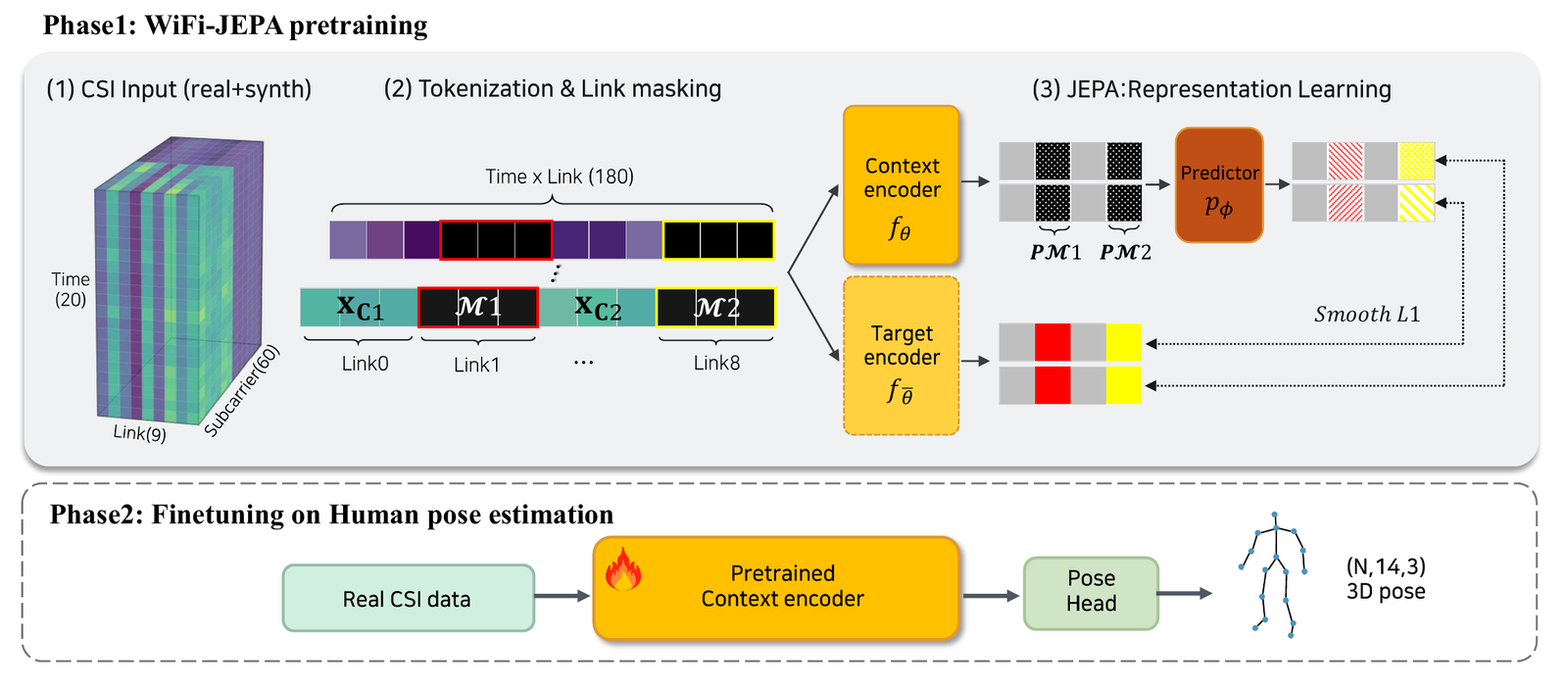
Phase 1: self-supervised pre-training with link masking on the (T, L) token grid. Phase 2: supervised fine-tuning with a PETR decoder for multi-person 3D pose.
Sim-Obj in Action
We pre-train on ray-traced CSI from scenes of simple bouncing geometric primitives — no human models or motion capture. As an object moves, ray tracing computes the channel and the CSI varies accordingly. It is this dynamics diversity, not geometric realism, that makes the representation transfer: ~90K simulated frames match ~90K real frames for pre-training, and combining both yields the best result.
Interactive demos. Left: a primitive moving while ray tracing computes the channel; right: the resulting CSI changing over time. Top: single RX; bottom: 1 TX × 3 RX (PiW3D layout). Use prev / play / next to step through pose frames.
Results
On PiW3D — the only public multi-person WiFi-CSI 3D benchmark — WiFi-JEPA sets a new state of the art, improving single-person MPJPE by 14.7% over the previous best (DT-Pose) and reducing multi-person error from 107.2 to 93.5 mm. Adding simulated pre-training data improves both settings further.
| Method | Venue | SP MPJPE ↓ | SP PCK@20 ↑ | MP MPJPE ↓ | MP PCK@20 ↑ |
|---|---|---|---|---|---|
| WiPose | MobiCom'20 | 101.8 | — | — | — |
| MetaFi++ | IoT-J'23 | 132.0 | 62.0 | — | — |
| HPE-Li | ECCV'24 | 120.2 | 59.1 | — | — |
| DT-Pose | arXiv'25 | 90.0 | 72.1 | — | — |
| PiW3D (baseline) | CVPR'24 | 91.7 | 69.3 | 107.2 | 58.1 |
| WiFi-JEPA (real) | Ours | 78.2 | 74.5 | 97.1 | 59.3 |
| WiFi-JEPA (real+sim) | Ours | 76.8 | 75.9 | 93.5 | 61.5 |
MPJPE in mm; PCK@20 in %. SP: single-person, MP: multi-person.
We further evaluate cross-domain generalization under a leave-one-environment-out protocol — pre-training and fine-tuning on two of the three environments (office, classroom, corridor) and testing on the held-out one. WiFi-JEPA nearly halves the cross-environment error of the PiW3D baseline.
Supplementary Visualization
Interactive WiFi-JEPA pose estimation results on PiW3D test frames — ground truth: red, prediction: blue.
Drag to rotate and scroll to zoom, and double-click to reset the view.
BibTeX
@inproceedings{kim2026wifijepa,
  title     = {WiFi-JEPA: Self-supervised Learning for WiFi-CSI 3D Human Pose Estimation},
  author    = {Kim, Doeon and Lee, Jungyoon and Kim, Seongsin and Kim, Seong-heum},
  booktitle = {Proceedings of the European Conference on Computer Vision (ECCV)},
  year      = {2026}
}